
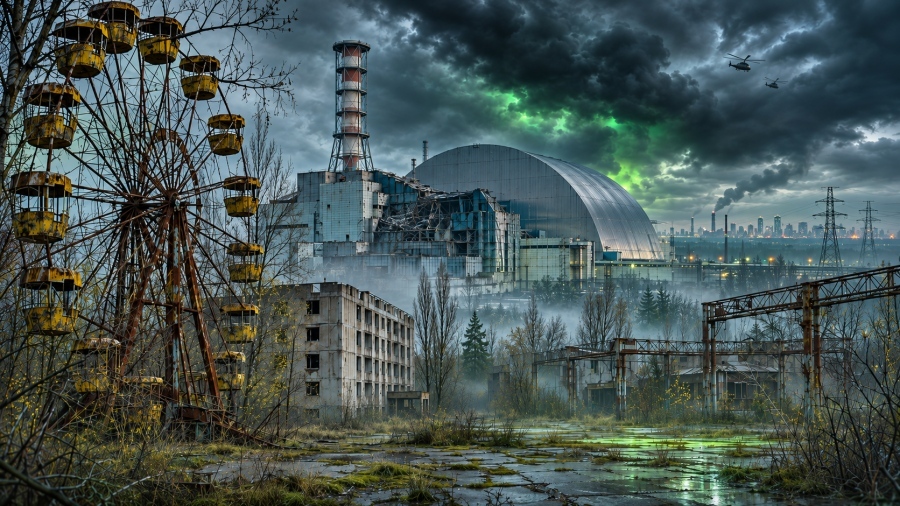
The 1986 Chernobyl nuclear disaster was not merely one of the largest technological accidents in human history. It constituted a turning point for the Soviet Union, exposing the weaknesses of an entire state apparatus, the extent of bureaucracy, and, above all, the consequences of the political leadership concealing the truth. Five years later, the Soviet superpower collapsed, having first lost the trust of its citizens. Nearly four decades later, the tragedy returns to the forefront through an alarming comparison with today's West. The dependence of state mechanisms on powerful economic interests, the relationship between science and political power, as well as the rapid spread of artificial intelligence, bring back the danger of a new crisis of trust, with unpredictable consequences for modern societies.
The beginning of the end for the Soviet Union
The HBO miniseries "Chernobyl" dramatizes the events of the 1986 nuclear disaster. The series captures the clash between scientific truth and political expediency, highlighting the manner in which the Soviet bureaucracy handled one of the greatest crises in the country's history. However, Chernobyl was not merely an unspeakable human and environmental tragedy. It dealt a decisive blow to the credibility of the Soviet state, as it revealed that those at the pinnacle of power either did not know the true extent of the disaster or chose not to disclose it. The political leadership and party officials sought reassuring information, while unpleasant news was restricted or suppressed. Scientists were called upon to provide solutions, yet when their warnings collided with government objectives, they risked being sidelined or blamed for the disaster itself. At the same time, citizens lacked a full picture of the dangers. Children continued playing in areas exposed to radiation, while workers and rescue crews were sent into extraordinarily hazardous conditions to contain the fallout of the disaster. The gap between reality and official briefings grew wider by the day.
The moment the people stopped believing those in power
What proved decisive was not solely the scale of the nuclear disaster, but the definitive breach of trust between society and the political leadership.Chernobyl confirmed citizens' worst suspicions that those governing could endanger the health and lives of an entire population in order to protect their reputation and maintain control of the situation.Mikhail Gorbachev referred to the disaster in his autobiography, pointing out its significance for the trajectory of the Soviet Union. The nuclear accident constituted one of the decisive factors that accelerated the disintegration of the Soviet system. This crisis did not unfold in a political vacuum. A few years later, in 1991, the Soviet Union dissolved. Boris Yeltsin, who had entered into open confrontation with the old party leadership, appeared atop a tank outside the Moscow White House, directly challenging the authority of the Soviet regime. The dissolution of the superpower was accompanied by the independence of the Soviet republics and political upheavals across Eastern Europe. The old system had by then lost its cohesion and legitimacy.Chernobyl encapsulates the moment when state authority loses society's trust and its inability to manage the consequences of its own decisions is laid bare.
The US, vaccines, and the clash with financial interests
The same question carries over to the US, with arguments that the crisis of trust toward institutions now constitutes one of the most serious problems in American society. The handling of the pandemic serves as a characteristic example. mRNA vaccines, which were supposedly meant to tackle the pandemic, caused harm on a massive scale, as we now know from the government's own vaccine injury reporting systems. Both VAERS and v-safe record tens of thousands of injury cases, a figure that potentially corresponds to millions. In the mainstream media, little to no mention is made of this grim reality. Meanwhile, the process of modifying mRNA and delivering it via lipid nanoparticles continues, with a new flu shot available at your local pharmacy. These specific formulations have been on the market for barely two months. Reports of injuries are pouring into the VAERS system (see mFLUSIVA on OpenVAERS.com). It is truly unthinkable that this situation is allowed to continue. These specific vaccines had already caused human deaths during clinical trials, and yet they remain on the market and are not withdrawn, despite the high number of injuries they have caused. The industries behind these products are overly powerful, and the regulatory bodies are overly dependent on their money. In reality, the same applies to the industry itself. This is no secret. It is something everyone knows, yet no one can report - much less change. The situation is no different from the Chernobyl incident. The people who built and maintained the nuclear power plant could not - and would not - admit the scale of the disaster they caused. The public was not informed until it was already too late.
"We must start telling the truth"
One of the most iconic scenes in the series on Chernobyl takes place in the fourth episode. Two scientists consider striking a deal with the KGB to conceal the truth about the disaster in exchange for the opportunity to fix flaws in other nuclear reactors. At that point, one of the two recounts the story of a mother who lost her baby due to radiation exposure. The woman states that she does not want to live in a society capable of tolerating such a reality and concludes with a line that encapsulates the entire message of the story: "We must start telling the truth." This, according to the columnist, is the essence of the lesson of Chernobyl. A state may possess immense economic, military, and technological power, yet when it loses the trust of its citizens, its very foundation begins to crumble. The Soviet Union did not collapse solely because of the economic crisis or political disputes. The loss of trust toward the leadership and the questioning of the credibility of the state apparatus constituted critical dimensions of its historic collapse.Chernobyl remains, therefore, a warning that transcends the geographical and political boundaries of its era. Technology may change, states may transform, and balances of power may be overturned, yet the problem remains the same: what happens when those holding the authority to decide cannot manage the consequences of their choices and, instead of informing society, choose to conceal reality? Because the Soviet Union did not collapse when its citizens merely stopped obeying. It collapsed when they stopped believing those who governed them. And that is a lesson today's West cannot afford to ignore.
www.bankingnews.gr



Σχόλια αναγνωστών